
What is Computer Science?

Sep 19, 2025
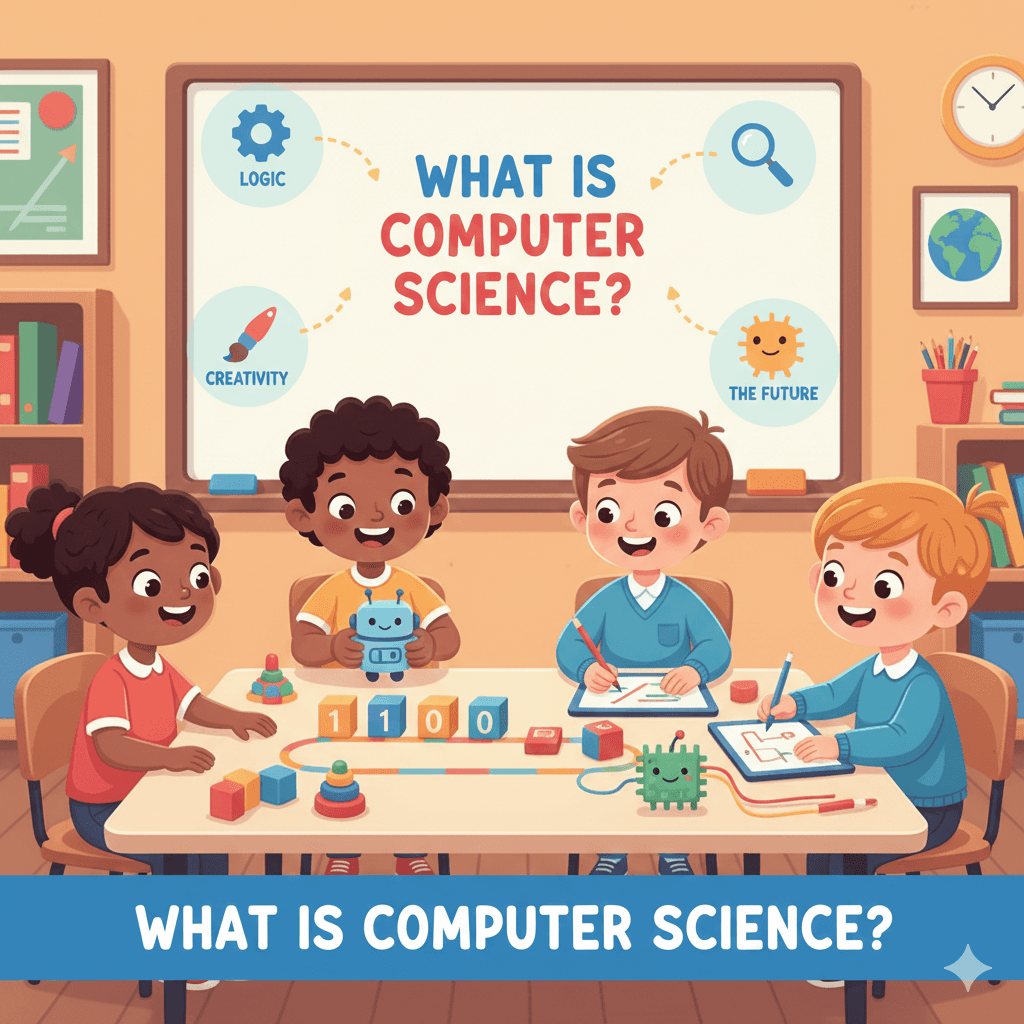
"We want students to understand what a computer can do, what a human can do, and why that’s different,” says Mark Guzdial, Professor of Computing at Georgia Tech. When it comes down to it, that’s all computer science really is: the relationship between humans and computers. Computer scientists use their creativity hand-in-hand with technology to solve real-world problems.
Traditionally, computer science can be defined as the creation of programs and algorithms that assist in the development of software, systems, and networks. This involves lots and lots of programming, or coding. While coding is certainly an important part of computer science, it’s only one part of the field. Computer scientists need to use critical thinking to tackle problems from abstract (What kinds of problems can we solve with this algorithm?) to tangible (How could we turn this into an iPhone application so people can access this information on the go?).
This understanding of computer science leads to much broader applications. ANYONE that uses technology to solve problems can be considered a computer scientist!
The History of Computer Science (In 5 Parts)
Computer science has only emerged recently, right? Well, not so fast! Computer science has a long and rich history, starting in 2400 BCE. Here are some highlights:
2400 BCE - Abacus
In the early days of computer science, “computers” weren’t machines - they were people! These people needed tools to help them make calculations. That’s when the abacus was invented: the earliest known tool for computing. Mathematicians moved the beads back and forth to assist in their computation.
1700s - Binary System
German mathematician Gottfried Leibniz developed the binary system. In binary code, 0s and 1s are used to represent a wide variety of values, like letters, numbers, or characters.
1830s - Analytical Engine
Charles Babbage and Ada Lovelace are two mathematicians credited with founding modern computing. Babbage invented the Analytical Engine, an early computer powered by steam. Lovelace wrote the directions to the Analytical Engine - in algorithms, of course! Her work showed step-by-step processes for the different uses of the engine.
1930s - Transition from Analog to Digital
The start of World War II led to the transition from analog computers, powered by electricity, mechanical parts, or water, to digital computers, computers powered by circuits, relays, and vacuum tubes.
1960s - Present Day - Constant Innovation
Innovations in computer processing and memory made computers more available commercially. Even today, we’re seeing constant advances in technology, making computers smaller, faster, and more affordable. For more information, check out this list of the 30 most influential computer scientists that are still alive today.
Popular Technologies That Use Computer Science
You would be hard pressed to find any modern technology that doesn’t use computer science. In fact, looking at Lafayette College’s list of Top 30 Innovations, computer science impacts every. Single. One. Since we can’t talk about the whole list, let’s dive into 3 examples of technologies across the sectors of biology, gaming, and social networking that use computer science daily.
DNA Testing and Sequencing
Companies like 23 and Me and Ancestry use DNA samples to determine everything from origin and ethnicity to genetic health risks. Scientists use genotyping, which compares your DNA to a sample set of DNA to determine differences. This, of course, is all done via an algorithm on a computer! Another way these companies use computer science is through data collection and presentation. The beautiful and easy-to-read charts you receive are designed and compiled by a computer scientist.
4K TVs and Compatible Gaming Systems
4K is a relatively new display resolution for screens; its display is 3840 x 2160 pixels, or four times the pixel count of an 1080p HDTV. Basically, a 4K TV will look sharper than most TVs on the market.
The recently released Xbox Series S/X and Playstation 5 are both compatible with 4K monitors. Although competitive players in the industry still use 1800p screens for quick and precise movements, 4K is ideal for story-based gaming with beautiful graphics. And with the price of 4K monitors coming down, it’s clear this technology isn’t going away any time soon.
File Compression and Social Networking
File compression occurs when the size of a file is converted, or re-encoded, so it uses less space. That way, files can be easily shared, transferred, and stored. What is responsible for this technology? Computer science, of course!
File compression is particularly important for social networking sites. As you upload media to platforms like Facebook, Twitter, Instagram, and LinkedIn, the files are compressed to fit hosting guidelines and storage capacity. This is especially important for video content, since those files tend to be HUGE! You can thank file compression next time you scroll through TikTok with little to no buffering.
Types of Jobs in Computer Science
As we mentioned in the first section, computer science is when people use their creativity hand-in-hand with technology to solve real-world problems. As a result, the field of computer science is wildly diverse! These days, MOST careers rely on knowledge of computer science or computer science skills. Here are five examples of computer science careers - a far from exhaustive list, but hopefully seeing some sample job titles is inspiring! Click on each job title to learn more about that particular career.
---
And that wraps up our brief study of the question, “What is computer science?”. There’s still SO much more to explore! With a true lifetime of learning already available and new innovations yet to discover, there is boundless opportunity for young students to be introduced to computer science early in life. Take a moment to explore our computer science curriculum offerings for grades K - 12. Who knows what our students have yet to write in the computer science history books!